Books, podcasts and good conversations take you as far as understanding. The Whole Human Workshop is four hours of doing: writing, mapping, a light guided practice and plain-English lessons on how money and institutions work. You leave with one written commitment and a partner who will check in with you.
A two-minute application. For business owners and professionals 2–3 years into their careers.
“His expertise in identifying the beliefs you hold and bringing them to the surface is extremely commendable.”
Akshay · from 1:1 work with JaswanthThere is a ladder between hearing an idea and living it. Almost everything sold as personal growth delivers the first two rungs. The third one is where change actually happens, and it can’t be built by reading anything, including this page.
You’ve heard the idea. You could repeat it back.
You can explain your own pattern fluently, and why it happens.
You respond differently in the moment it matters. This takes doing, repetition and someone holding you to it.
So every block of the day is built the same way: a short teach, then an exercise you do on paper, in pairs or in your body, then a few people share. Four hours can’t finish that work. It can start it properly.
This isn’t beginner self-help. It’s for people who have already done a lot and notice something still doesn’t add up. Most see a piece of themselves in one of three patterns, or all three. They’re introduced in the first fifteen minutes and named, gently, whenever they show up in the room.
Has read the books and can explain her patterns fluently. And repeats them anyway.
“Knowing your patterns is not the same as changing them.”Has seen through the system so thoroughly that he’s stopped engaging with it, and calls that clarity.
“Seeing through the system is not the same as building a life inside it.”Hits every goal. The gap she hoped each one would close keeps widening instead.
“You keep getting there. So why doesn’t it feel like arriving?”Each pillar is useful. Each one, done alone, has a shadow. The day moves through them in sequence, and the sequence is never shuffled.
Self-awareness, emotional awareness, inner connection.
Alone: bypassingHow money, banking, institutions and technology shape the world.
Alone: cynicismActing from a clean inner place, as a builder or a giver.
Alone: burnout or egoSkills, resources, systems, and the mechanics of manifestation.
Alone: burnout or egoBecome aware first. Then understand the world. Then act.
Most people start at the end.
Short teaching, then an exercise, then two or three people share. Nobody is made to speak. Phones stay away, and what’s said in the room stays in the room.
Three short stories (Ananya, Vikram, Devika) give the room a shared language for the day. Then one question, held in silence: what makes someone fully alive, versus just functioning? It isn’t answered here. By the end of the day you’ll have your own answer, not someone else’s.
Three exercises, each building on the last.
Once upon a time… Every day… Until one day… Your life so far, written the way you tell it to yourself at night. Then: what role are you playing, and what mood runs through it?
List five values. For each: when has honouring it actually cost you something? A value that has never cost you anything is often inherited, not chosen.
What you’ve said you want, next to what you keep getting instead. The pattern in the second column is data, not failure.
A belief like the one you found in block 01 usually isn’t a thinking problem. It got wired in through an experience, and the feeling never finished. This block moves one small piece of it from understood to felt.
A pocket card of thirty emotion words. Circle the ones you rarely let yourself feel, underline the ones that are always on. Precise naming is the cheapest tool there is.
Pick one recent situation where your belief showed up, and only one with a charge of 4 to 6 out of 10. Where you feel it in your body, and what you believed in that moment.
A short guided practice: settle, notice, name, let a small version of the feeling move, then write a letter you never send. Then a new sentence, and one small action for this week.
This is a workshop, not therapy. The practice is light and clearly bounded, not trauma work.
Three real mechanics, each followed straight away by what it means for you. Clear enough to avoid naivety, and steady enough to avoid cynicism.
When a bank makes a loan, it creates new money in that moment; it doesn’t lend out someone else’s savings. Then: where do you hold money back out of fear, and where do you move it with intention?
Every platform, employer and bank keeps a share of the value that flows through it. Seeing that clearly without giving up, and getting better at receiving your fair share of money, help and credit.
Phones out for two minutes: your real screen time and top three apps, next to what you said you want. Then a short look at how schooling graded your sense of worth.
Two people can chase the same goal from very different places: one building something useful, one still proving a point. Same hours, very different cost. This block checks where your drive is coming from.
Four questions on your main goal, starting with: if nobody would ever know you achieved this, would you still want it? Then the goal rewritten from a cleaner place.
Which mode you’re in this season of your life, and what burnout or ego looks like for you in it.
Nine statements, three per pattern. The column you tick most is the one you lean towards: Ananya, Vikram or Devika. Then one line on what it has been costing you.
Taught as mechanics, not magic: clarity, belief, attention, inspired action, allowing and receiving. You don’t need to believe anything on faith. Your outer life tends to reflect your inner state in the patterns you control, never in accidents, other people’s choices or injustice.
Not a mystical reading. Two trackable things: your dominant felt state, and what your attention has been on. Then check them against your rewritten goal.
Your goal written as already done. The specific felt sense of it being true. The gap from where you are now. A few minutes of daily practice of that state this week.
The skill, resource and system your goal needs, one person who has done it from a start like yours, and one dated next step: “By [date], I will…”
The morning’s question, answered by what the room just did. You draw your Whole Human Map card from the four scores you gave yourself during the day. Then the part most workshops skip: one commitment written as “By [a date within two weeks], I will [specific action]”, read to a partner who checks in with you in a week, and a sealed note to yourself to open on day 30.
Where you stand on all four pillars, scored as you go through the day and drawn on a card you keep.
Which pattern you lean towards (Ananya, Vikram or Devika), and what it has been costing you.
How money, institutions and education shape the choices you thought were entirely yours.
One concrete action with a date on it, from the frequency-matching worksheet, and a partner who checks in.
In your hands: a printed 16-page workbook with every exercise from the day, your Whole Human Map card, a pocket card of emotion words, and a sealed note to open on day 30.
Groups of three or four for pair work. The whole room is capped at 15 people.
Two or three volunteers share after each exercise. You can always just write.
This is the first time the workshop runs. Your feedback shapes the full-day version that follows.

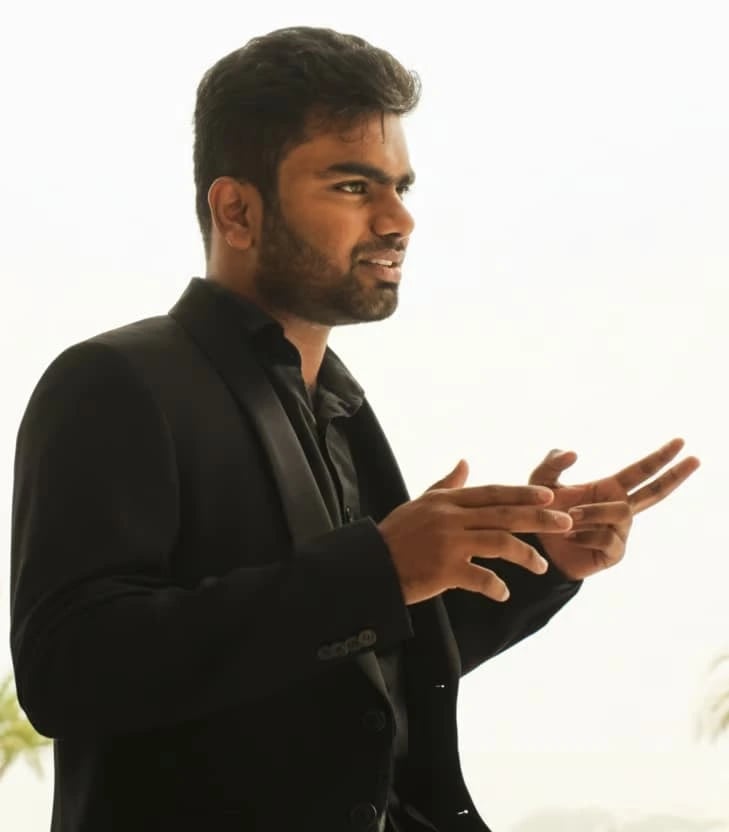
His background isn’t spiritual. It’s deal rooms and public infrastructure, which is why the inner work and the money-and-institutions block sit side by side in this workshop.
These come from 1:1 work with Jaswanth. This is the first workshop.
Results are individual and not typical.
The blocks always run in this order, with a 15-minute break after block 02. Doors open at 9:30.
No. It’s one block of four, and it comes after self-awareness, emotional awareness and a plain-English look at how money and institutions work. It’s taught as a working lens with practical definitions, and it ends in one concrete action. You can test it rather than take it on faith.
No. The emotional awareness block includes a light, guided practice on one small, recent situation you choose yourself: settling, noticing where a feeling sits, naming it, and writing a letter you never send. You stay in control throughout, can stop at any step, and can step out for a quiet minute whenever you need one. It isn’t clinical or trauma work. If you’re going through a crisis or need clinical support, please speak to a qualified professional first.
No. Most exercises are private writing. After each one, two or three volunteers share a single sentence if they want to. Some exercises are in pairs. What’s said in the room stays in the room.
Near the end, Jaswanth briefly shares what going deeper looks like for anyone who wants that, because four hours can start this work but not finish it. It’s short and optional. Your seat today is complete on its own.
Who’s in the room matters as much as what’s taught. Pair work and discussions only work when everyone has come to do the work. The form takes about two minutes.
If it looks like a good fit, you go straight to a secure payment page to confirm your seat. If you’d like to understand more first, we show you a short page with straight answers.
₹10,000 per seat, GST included. You pay securely online (UPI, cards, netbanking) after your application.
Seats are non-refundable. Please apply only if you can attend on Saturday, 17 October, 10am to 2pm.
Yes. The room is for both business owners and professionals around 2–3 years into their careers.
Nothing. You get a printed workbook, a pen and your Whole Human Map card. Water is provided but no food is served, so have breakfast before you come. Doors open at 9:30; please arrive a few minutes early and stay for the full four hours. Each block builds on the one before.
Saturday, 17 October 2026 · 10am – 2pm · The Executive Centre, HITEC City · ₹10,000 incl. GST
By applying, you agree to receive WhatsApp and email messages about this workshop. Reply STOP anytime. Your details are used only for this workshop.